

How to Use Word Study Without a Seminary Degree
The Hebrew and Greek behind your Bible can open a verse wide, if you handle them honestly.
By Kiel Harvey, founder of RockReader
There is a moment that happens to everyone who reads the Bible long enough. You are moving through a familiar passage, and a single word snags you. Love, or fear, or rest. And a question surfaces: what did that word actually mean, before it made the long trip into English?
Most people assume answering that question requires a seminary degree, so they let it go. That is a shame, because the question is a good one, and answering it has never been more accessible. You do not need to know Hebrew or Greek to learn something real from the words behind your Bible. The original writers chose specific words on purpose, and seeing one up close can open a verse in a way that reading past it never will.
RockReader has a word study tool built in, free, for exactly this moment. Here is how to use it, and just as important, a simple method for using word studies well, because a word study handled carelessly can mislead you as efficiently as it can teach you.
What a word study is
A word study is slowing down on a single word to ask three questions: what did the original Hebrew or Greek word mean, where else does Scripture use it, and does that change what this verse is saying. That is the whole discipline. Everything else is technique.
Here is why it is worth doing. Every English Bible is a translation, which means every English Bible involved thousands of judgment calls. One Greek or Hebrew word might be rendered several different ways in English depending on context. And a single English word might stand in for several different originals: the "love" in one verse and the "love" three chapters later may be entirely different words in Greek, carrying different weights.
None of this means your translation is wrong. Translations are careful, scholarly work, and the major ones are trustworthy, though they differ in ways worth understanding when you are weighing the best Bible translation for study. But it does mean there is texture under the English surface, and sometimes that texture is where the insight lives. A word study is how you reach it.
How it works in RockReader
Word study lives in Read & Study, your free reading pane, so it never clutters your daily journaling. It follows three small steps:
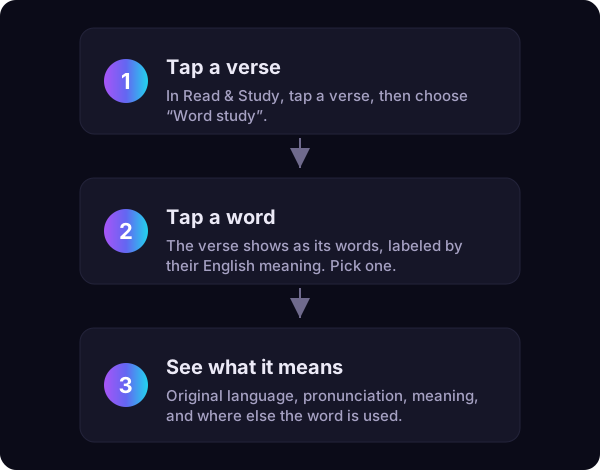
- Open Read & Study and tap a verse. In the actions that appear, choose Word study.
- The verse opens as its individual words, each labeled by its English meaning so you can find the one you are curious about. Tap it.
- The word opens up: its original Hebrew or Greek, how it is pronounced, what it means, and where else it appears in Scripture.
That is the entire flow. Tap a verse, tap a word, read. No accounts to upgrade, no lexicon to buy. The data comes from STEPBible (CC BY), the same scholarship many study Bibles rely on.
What each part means
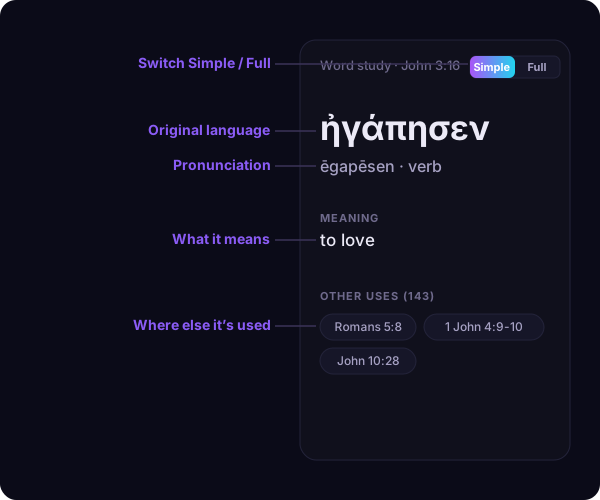
At the top is a Simple / Full switch. Simple keeps it to the essentials: the original word, how to say it, and its meaning. Switch to Full when you want more, like the part of speech, a longer definition, and the full list of other places the word is used. Start simple. Turn on Full when a word grabs you and will not let go.
"Other uses" is the part most people find surprising, and it is quietly the most valuable panel in the tool. Tapping through to the other verses where the same word appears is the heart of a good word study, because Scripture is its own best dictionary. Watching how Paul uses a word across three letters teaches you more about what he meant by it than any definition can. Definitions tell you what a word could mean. Usage shows you what it does mean, in the hands of the writer you are reading.
A simple method for word studies
You do not need a degree. You need a little patience and a good question. Here is a method that holds up, and if you would rather work it out on paper there is a printable word study worksheet that walks the same five steps:
- Pick a word that carries weight. Not "the" or "and." Choose a word the verse leans on: love, hope, redeem, fear, walk. If the verse would collapse without it, it is a candidate.
- Read its meaning, then read it in context. The meaning is a starting point, not the answer. Always come back to the sentence the word is sitting in. A definition floating free of its verse is trivia; anchored in its verse, it is insight.
- Follow it to other places. Use "Other uses" to see how the same writer, and other writers, use the word. Patterns will start to show, and the patterns are the payoff. The word for "rest" in one Psalm, traced through its other appearances, can turn out to be a thread running through the whole story of Scripture.
- Ask what it adds. Does knowing the original word sharpen the verse, correct a wrong impression, or simply confirm what you already saw? All three are worth something. Confirmation is not a wasted study; it is your translation earning your trust.
- Write it down. A sentence in your journal, like "I did not realize this word also means...", is how a word study becomes part of you instead of a fact that evaporates by lunch.
A worked example: the famous "be still" of Psalm 46:10. Tap into the Hebrew and you find raphah, which carries the sense of letting drop, releasing your grip, ceasing to strive. That is not a mandate for quiet posture. It is a command to let go of the thing your knuckles are white around. The verse does not change, but it comes into focus, and you will never read it quite the same way. Ten minutes, no Hebrew degree, one verse permanently sharpened.
A few honest cautions
Word studies are powerful, which makes them easy to misuse. The internet is full of sermons built on a word study gone wrong. A few guardrails:
A word means what it means in its sentence, not the sum of everything it has ever meant.
- One word rarely settles a debate. Context and the whole counsel of Scripture do, which is why working through an entire book will teach you more than a hundred word studies. If your word study is about to overturn a doctrine, slow down considerably.
- A word's history is interesting but not decisive. How it is used here matters more than where it came from. English speakers say "goodbye" without meaning "God be with ye," and Greek speakers had dead metaphors too.
- Resist the "fuller meaning" temptation, where a word is loaded up with every sense it carries anywhere. A word in a sentence means one thing at a time.
- If a discovery seems to overturn the plain sense of the passage, the plain sense is usually right, and the discovery is usually a stretch.
Used with that humility, a word study is one of the most rewarding things you can do in personal study. It turns a familiar verse back into something you have to look at again, and "look again" is half of what study means.
Where to go next
Open Read & Study, or print a blank worksheet, pick a verse you think you already understand, and study one word in it. That last part is the fun of it: the verses you know by heart are the ones with the most room to surprise you. You may find, as most people do, that the word you have read a hundred times has been holding something extra the whole time, waiting for you to ask.
Built-in word study like this is one of the things worth looking for when you choose a daily Bible app, and it pairs naturally with a daily journaling habit: read, snag on a word, study it, write one line about what you found. That small loop, repeated over a year, will quietly make you a better reader of the whole Book.
Frequently asked questions
What is a word study?
A word study is slowing down on a single word in a verse to ask what the original Hebrew or Greek word meant, where else Scripture uses it, and whether that changes how the verse reads. It is one of the oldest habits in personal Bible study, and it does not require knowing the original languages, only a tool that shows you the word and its other uses.
How do you do a word study?
Pick a word the verse leans on, not "the" or "and." Read its meaning, then read it back inside its own sentence. Follow it to the other places the same word appears and watch for a pattern, because usage teaches you more than any definition. Then ask what it actually adds to the verse, and write one line about it so the discovery does not evaporate. In RockReader you do this by tapping a verse in Read & Study, choosing Word study, and tapping the word you are curious about.
Do you need to know Greek or Hebrew to do a word study?
No. A word study tool gives you the original word, its pronunciation, its meaning, and every other place it appears, which is the part that does the teaching. Knowing the languages helps, but the honest limits of a word study apply to scholars too: a word means what it means in its sentence, and no single word settles a question that context has not already answered.
Can a word study be wrong?
Yes, and it is the most common way study goes off the rails. The usual mistakes are loading a word with every sense it carries anywhere, treating its history as more important than how it is used here, and letting one word overturn the plain sense of the passage. If your word study seems to overturn a doctrine, the plain reading is almost always right and the discovery is almost always a stretch.
RockReader is a private, ad-free Bible journaling app and daily devotional. Read, reflect with the SOAP method, and share with your small group only when you choose.
Create your free account